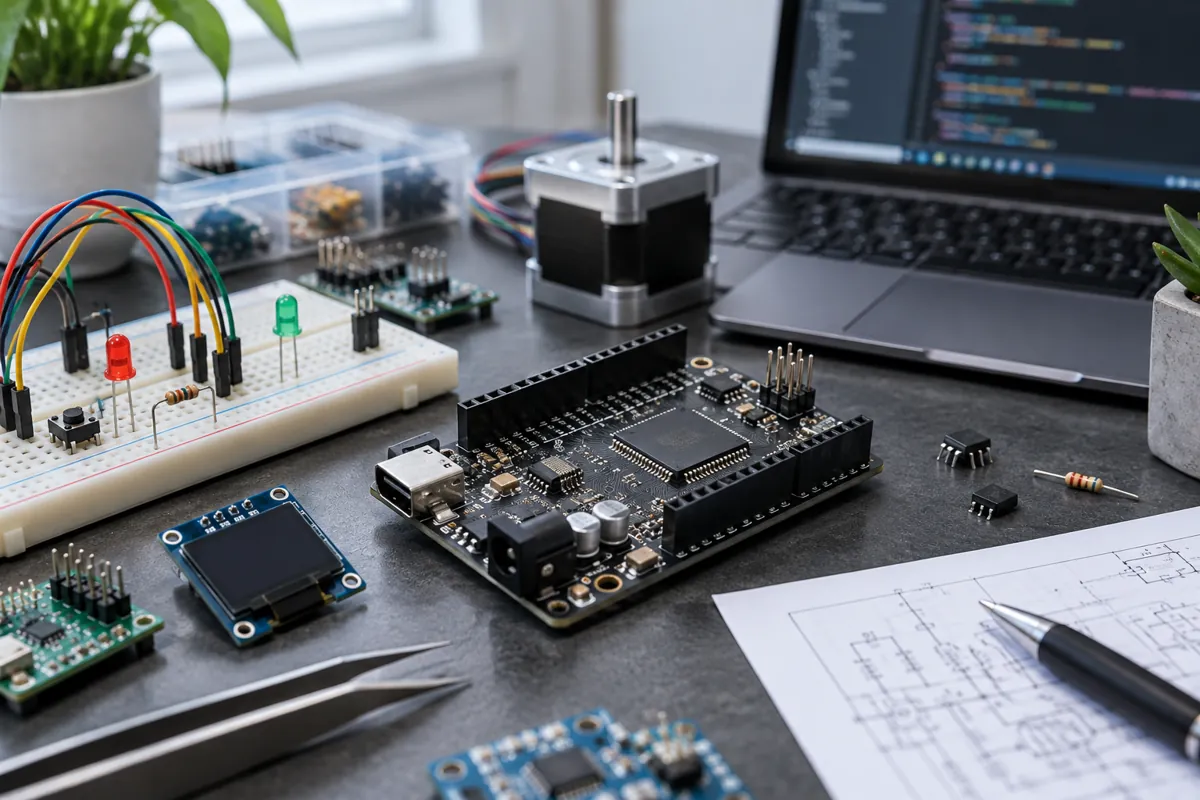
Hardware & Microcontrollers
Arduino, Raspberry Pi, sensors and embedded projects
Introduction
Hardware and microcontrollers form the backbone of modern electronics development. They enable creators, engineers, and hobbyists to design devices ranging from simple sensors to complex automation systems. Understanding these components is essential for anyone aiming to innovate in the field of embedded systems or IoT (Internet of Things).
As technology advances rapidly, the relevance of hardware knowledge grows. With over 20 billion microcontrollers produced globally in 2022, the industry continues to expand at a compound annual growth rate (CAGR) of around 8 percent. This surge reflects the increasing integration of microcontrollers into everyday objects such as smart home devices, automobiles, and wearable tech. The significance of mastering hardware components extends beyond hobby projects to high-stakes commercial applications and career opportunities.
Definition and core concepts
Hardware refers to the physical components of electronic systems, including microcontrollers, sensors, actuators, and power supplies. A microcontroller is a small, integrated circuit that contains a processor, memory, and input/output peripherals. It operates as the brain of embedded systems, executing programmed instructions to control devices and gather data.
Core concepts in hardware and microcontrollers include architecture, peripherals, and programming. Microcontroller architectures such as ARM Cortex-M, AVR, and PIC define instruction sets and system design principles. Peripherals like ADC (analog-to-digital converters), UART (serial communication interfaces), and PWM (pulse-width modulation) enable interaction with sensors and actuators.
In practice, a microcontroller takes input from sensors—such as temperature or motion detectors—processes the data, and then triggers outputs like motors or indicators. This cycle forms the basis of embedded control systems. The choice of hardware depends on factors like power consumption, processing speed, and I/O requirements, shaping the overall system performance and efficiency.
How it works
Microcontrollers operate on a simplified computer architecture. They have a main processor core that executes instructions stored in memory. Typical programming involves writing code in languages such as C or assembly, which is then compiled into machine language the microcontroller can understand.
The microcontroller's input/output systems connect to sensors and actuators via specific interfaces. For example, analog signals from sensors are often read through ADC channels, converting them into digital data. Digital output pins control devices like LEDs or relays. Communication protocols such as I2C, SPI, and UART enable interaction between multiple microcontrollers or peripheral devices.
Power management is a key aspect. Many microcontrollers feature sleep modes that reduce power consumption to microampere levels, extending battery life in portable devices. The process typically starts with code deployment using programming environments like Arduino IDE, STM32CubeIDE, or MPLAB X. Once programmed, the microcontroller runs in a continuous loop, monitoring inputs and adjusting outputs based on programmed logic.
The performance of a microcontroller depends on its clock speed—ranging from as low as 8 MHz in low-power devices to over 400 MHz in high-end variants. Memory size also varies; common microcontrollers feature from 16 KB to 2 MB of flash memory and from 2 KB to 512 KB of RAM, influencing the complexity of the software that can run.
Hardware design involves creating circuit schematics and layouts, often using tools like KiCad, Eagle, or Altium Designer. Ensuring signal integrity, proper grounding, and avoiding electromagnetic interference (EMI) are critical for reliable operation. After prototyping, devices are assembled on PCBs, tested, and fine-tuned to meet specific application requirements.
Practical application
Microcontrollers serve in various industries, powering everything from consumer electronics to industrial automation. The automotive sector uses microcontrollers extensively; for instance, modern vehicles contain over 100 microcontrollers controlling engine management, airbags, ABS, and infotainment systems. The demand for embedded hardware in cars is projected to grow at a CAGR of 12 percent through 2025.
The consumer electronics market benefits from microcontrollers in devices such as smart thermostats, wearables, and home security systems. For example, a smart thermostat may incorporate a microcontroller like the ESP32, which offers Wi-Fi connectivity, enabling remote control. These devices typically cost between $5 and $20 to produce in bulk, with retail prices ranging from $50 to $250 depending on features.
In industrial automation, microcontrollers control machinery and robotic systems. Programmable logic controllers (PLCs) are specialized microcontrollers used in factories. They manage real-time operations and safety protocols critical for manufacturing lines. The integration of microcontrollers in Internet of Things (IoT) networks allows for remote monitoring and predictive maintenance, reducing downtime and operational costs.
Medical devices, including infusion pumps and diagnostic equipment, rely on microcontrollers for precision and safety. Regulatory standards such as FDA approvals demand rigorous testing and validation of hardware systems. Cost considerations are stringent; a single device can incorporate multiple microcontrollers, with total hardware costs reaching several hundred dollars per unit.
Microcontrollers are integral in renewable energy systems too. In solar inverters and wind turbines, they optimize power conversion processes. With increasing adoption of smart grids, these embedded devices help manage energy distribution efficiently, supporting the transition toward sustainable power sources.
Common mistakes
One frequent error is selecting a microcontroller that does not meet the application's requirements. For instance, choosing a microcontroller with insufficient RAM or processing power can hinder system performance. Inadequate consideration of power consumption may lead to devices that drain batteries quickly, especially in portable applications.
Another mistake involves poor hardware design practices. Failing to include proper decoupling capacitors or ground planes can introduce noise and cause unpredictable behavior. Overlooking signal integrity during PCB design can result in communication errors, especially in high-frequency setups involving protocols like SPI or I2C.
Programming errors also occur; for example, not initializing peripherals correctly or neglecting to implement error handling routines. These oversights can lead to system crashes, data corruption, or security vulnerabilities. Testing under realistic conditions is vital to identify such issues before deployment.
Expert recommendations
Choosing the right microcontroller begins with defining system constraints. A standard recommendation is to assess the processing speed needed, input/output requirements, power budget, and cost. For simple projects, microcontrollers like the ATmega328P (used in Arduino UNO) are ideal, offering 32 KB of flash memory and 2 KB of SRAM at around $2 in bulk.
For more demanding applications, microcontrollers such as the STM32F4 series provide higher performance, with features including 180 MHz processing, 1 MB flash, and multiple peripherals. Selecting microcontrollers with integrated communication modules—like Wi-Fi (ESP32) or Bluetooth—can simplify hardware design and reduce overall system cost.
Designers should implement best practices in hardware layout. Proper grounding, short signal traces, and adequate decoupling capacitors improve system stability. When developing firmware, optimizing code for efficiency can significantly reduce power consumption and extend device lifespan.
Keeping up with the latest industry trends is equally important. For instance, the rise of microcontrollers supporting machine learning inferencing on-device, like the Arduino Nicla Vision, opens new pathways for intelligent automation in edge devices. Staying informed about emerging architectures and tools enhances development quality and reduces time to market.
Conclusion
Hardware components and microcontrollers form the foundational elements of modern embedded systems. Their design, selection, and implementation influence the performance, stability, and cost of a final product. As industries continue to adopt automation and IoT solutions, understanding these components becomes increasingly critical for engineers and developers.
From tiny sensors in wearable tech to complex control systems in automobiles, microcontrollers serve a variety of applications. Navigating their core concepts, how they function, and common pitfalls helps in creating efficient and reliable devices. Staying updated with industry standards and expert advice ensures optimization and future-proofing in hardware design projects.